For any shop running a CNC plasma cutting machine, consumables are one of the largest recurring expenses. Electrodes, nozzles, swirl rings, retaining caps and shields wear with every pierce and every arc start. When they wear unevenly or fail early, the cost is not just the part itself. Cut quality drops, bevel angles drift, dross increases and operators spend time grinding parts that should have come off the table ready to use.
The good news is that consumable life is largely controllable. Most premature failures come from a handful of avoidable causes: poor air quality, incorrect pierce height, mismatched parts, wrong current settings and arc stretching at the end of a cut. This guide covers each of these and explains how to build habits that keep a CNC plasma cutting machine productive and economical.
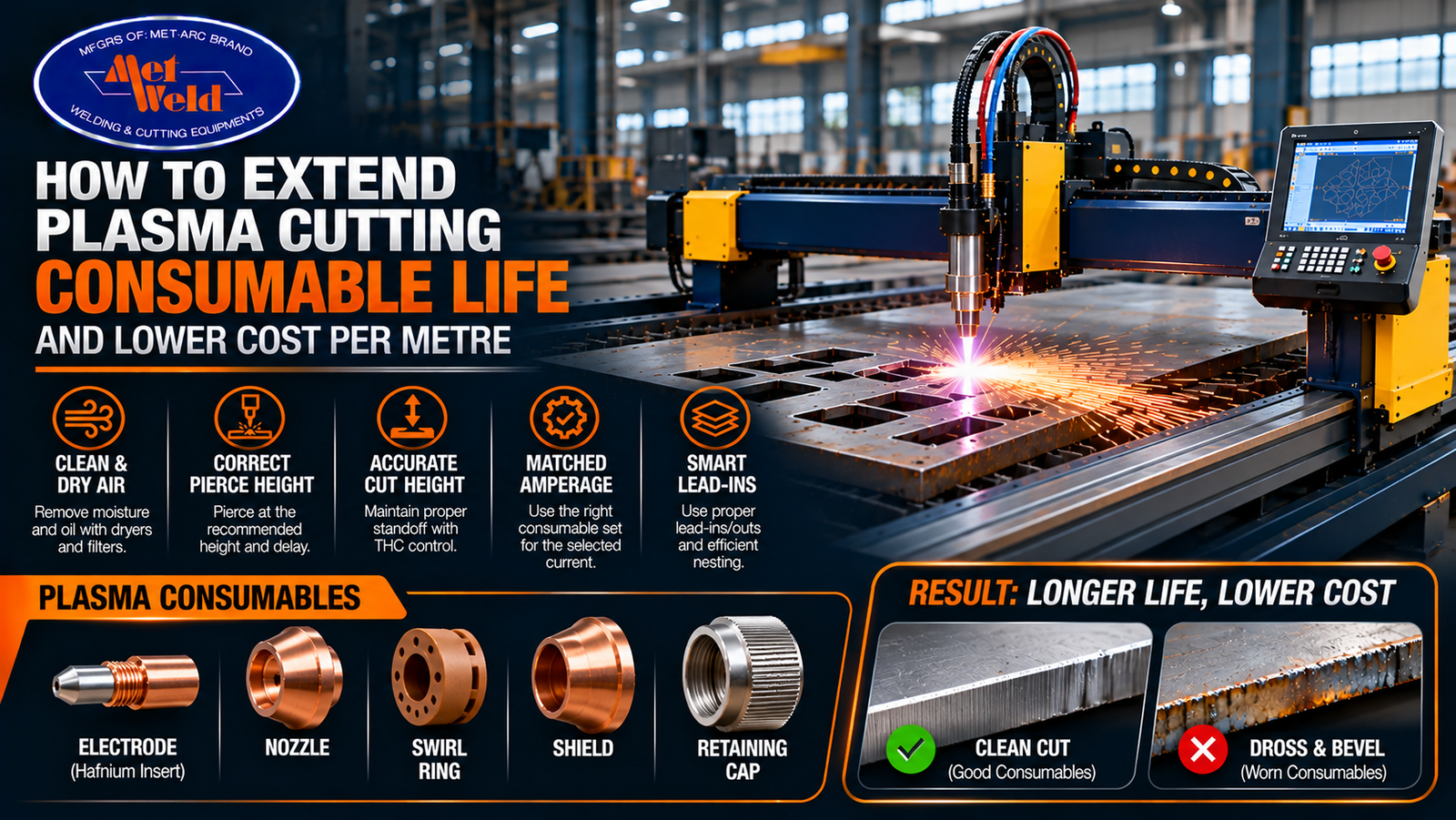
A plasma torch works by forcing gas through a small nozzle orifice while an electric arc passes from the electrode to the workpiece. The arc ionises the gas into plasma, which melts and blows away the metal.
The electrode carries a hafnium insert that emits the arc. Each arc start erodes a tiny amount of hafnium. Once the pit becomes too deep, the arc becomes unstable and can damage the nozzle.
The nozzle constricts the arc. Its orifice must remain round and sharp-edged to produce a narrow, focused arc. Any gouging or out-of-round wear widens the kerf and produces angled edges.
The swirl ring spins the gas to stabilise the arc, while the shield and retaining cap protect the front end of the torch from spatter and heat.
Most wear happens at arc start and arc stop, not during steady cutting. That single fact explains why piercing technique and lead-in design matter so much.
Moisture and oil in the air supply are the most common reasons consumables fail early. Water turns to steam in the arc chamber, disturbing the gas flow and attacking the electrode. Oil leaves deposits that cause double arcing.
Systems such as the Powermax105 and Powermax125 specify air quality clearly, and following those requirements pays for itself quickly.
Piercing throws molten metal straight back toward the torch. If the torch is too low during the pierce, that splash hits the shield and nozzle directly.
Getting this right is especially important for heavy work, which we cover in more depth in our article on CNC plasma cutting for thick metal.
Running the torch too close to the plate risks contact and double arcing. Running too high widens the kerf, increases bevel and stresses the nozzle. An automatic torch height control with arc voltage sensing keeps standoff consistent as the plate flexes or heats up.
Operators should verify the initial height sensing is working and that the height control is calibrated to the consumable set and current in use.
Every nozzle is designed for a specific amperage range. Running a 45 A nozzle at 65 A will destroy it quickly. Running a high-amperage nozzle at very low current leads to an unstable, wide arc and poor edges.
Keep a clear consumable chart at the machine, and make sure the cutting parameter library in the CNC is linked to the correct consumable part numbers for each material and thickness.
Arc starts and arc stops are where electrodes lose the most hafnium. Programming has a direct effect on how many starts happen and how cleanly the arc ends.
Efficient nesting reduces pierces as well as scrap. Our guide on nesting in sheet metal fabrication explains how to plan layouts for both material saving and fewer arc starts.
Mixing parts from different sets or using imitation consumables often looks cheaper on paper but costs more in practice. Small differences in orifice size, insert depth or swirl ring hole pattern disturb the arc and accelerate wear on every other part in the stack.
Replace parts as a set when appropriate. When the electrode is replaced, check the nozzle orifice carefully; a worn electrode often damages the nozzle in its final cuts. Metweld keeps genuine CNC machine spares for the plasma systems we supply.
Replacing consumables too early wastes money. Replacing them too late damages the torch and spoils parts. The best approach is a simple log.
| Part | What to check | Replace when |
| Electrode | Pit depth in the hafnium insert | Pit depth reaches the manufacturer’s limit |
| Nozzle | Orifice shape and inner wall | Orifice is out-of-round or gouged |
| Shield | Front face and holes | Spatter build-up or blocked gas holes |
| Swirl ring | Gas holes and body | Cracks, burn marks or blocked holes |
| Retaining cap | Threads and insulation | Damage or poor seating |
Recording arc starts and hours per set reveals trends. If life suddenly drops, it points to a change in air quality, programming or operator practice that can be corrected before it becomes expensive.
A damaged torch body, loose connections or a worn torch lead all affect arc stability. Slag build-up on table slats lifts plates unevenly and can cause the torch to collide or cut at the wrong height.
Include these checks in a weekly routine:
Our earlier article on the features and maintenance of CNC plasma cutting machines includes a broader maintenance checklist.
Operators who understand what a cut is telling them can catch consumable problems early. A gradually widening kerf, increasing bevel on one side, or more dross at the bottom edge are all signs that the nozzle or electrode is nearing the end of its life. A short training session on cut inspection often delivers a bigger saving than any change in equipment.
Shops that adopt these practices commonly see a meaningful increase in the number of pierces and cutting hours per consumable set. Just as important, cut quality stays consistent across the life of each set, which reduces grinding, rework and rejected parts. Over a year, that combination reduces cost per metre and frees operator time for productive work.
Metweld manufactures gantry type and table type CNC plasma cutting machines and integrates proven plasma power sources. Our installation and training support covers air supply, cutting parameters, consumable selection and inspection routines. For existing users, our service team can review cutting programs and consumable usage to identify where life is being lost.
Contact Metweld to discuss consumable supply, operator training or a plasma cutting setup review.
How long should a plasma electrode last?
Life depends on current, material and especially the number of arc starts. It is best measured in pierces and arc-on time and tracked in a log for your own jobs.
Should I replace the nozzle and electrode together?
Not always, but they should be inspected together. A badly worn electrode frequently damages the nozzle, so both often reach the end of life at about the same time.
Can wet air really damage consumables?
Yes. Moisture disturbs the arc and attacks the electrode insert, often cutting consumable life dramatically. Proper drying and filtration are essential.