When fabricators need to join thick plates over long seams, few processes match submerged arc welding for productivity and consistency. Pressure vessels, boiler drums, wind towers, storage tanks, large-diameter pipes, heavy beams and ship panels all rely on SAW for their main structural welds. Yet many shops that would benefit from it still depend on manual stick or semi-automatic MIG welding for long seams, accepting slower progress and more variation in quality.
This guide explains how submerged arc welding works, where it delivers the biggest advantage, and what equipment and preparation are needed to use it effectively.
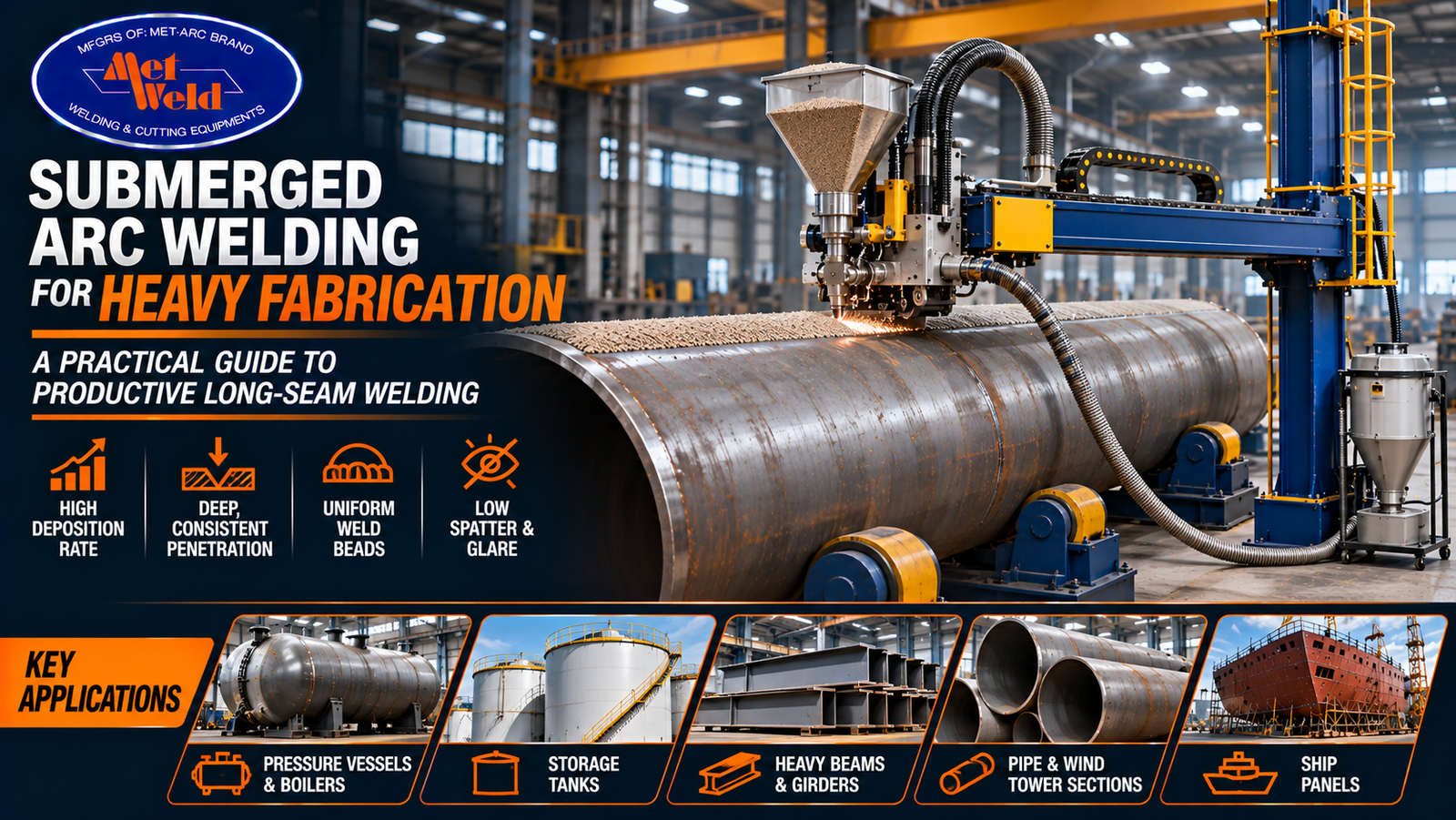
In SAW, a continuously fed bare wire electrode creates an arc with the workpiece. Unlike MIG or stick welding, the arc is not visible. It burns beneath a blanket of granular flux that is fed ahead of, or around, the wire.
The flux performs several roles:
Unfused flux is recovered and recycled, while the slag is removed after each pass. Because the arc is hidden, there is very little visible light, spatter or fume, which improves working conditions around the weld station.
SAW can run at high currents, depositing far more weld metal per hour than manual processes. On thick plates with multi-pass joints, this translates directly into shorter welding times.
High current and stable, mechanised travel produce deep penetration and uniform beads. This reduces the number of passes required and helps meet radiography and ultrasonic testing requirements.
With proper procedure control, SAW welds have low defect rates and good mechanical properties. Automated travel removes much of the variation that comes from operator fatigue on long seams.
Minimal arc glare and spatter make the process comfortable for operators and safer for people working nearby.
SAW is most effective in the flat position and for horizontal fillet welds, on joints long enough to justify mechanised travel. Typical applications include:
Our article on welding automation for pressure vessel manufacturing shows how SAW fits into a complete vessel fabrication line.
| Factor | SAW | MIG/MAG | Manual stick (SMAW) |
| Deposition rate | Very high | Medium to high | Low |
| Penetration | Deep | Medium | Medium |
| Positions | Flat and horizontal | All positions | All positions |
| Arc visibility | Hidden under flux | Visible | Visible |
| Spatter and fume | Very low | Moderate | Moderate to high |
| Best use | Long seams on thick plate | General fabrication | Site work, repairs |
SAW does not replace MIG or stick welding; it complements them. A typical heavy fabrication shop uses CO2 MIG/MAG welding machines for tack welds, short joints and positional work, and SAW for the long, thick seams where it saves the most time.
The wire and flux combination determines the chemistry and mechanical properties of the weld. Selection depends on the base material, required strength, impact toughness and the applicable code.
Flux must be stored dry, and baked according to the manufacturer’s instructions when required, to avoid hydrogen-related defects. Metweld supplies welding electrodes and consumables suited to industrial fabrication.
SAW performs best on well-prepared joints with consistent fit-up. Variations in root gap or bevel angle lead to burn-through or incomplete fusion.
A complete SAW setup includes more than a power source.
The value of SAW is easiest to see by comparing arc-on time per seam. Record how long a typical shell seam or beam flange takes with your current process, including passes, interpass cleaning and repairs. Then compare it with a SAW procedure for the same joint. Most fabricators find the savings come from three places at once: fewer passes, fewer repairs after radiography, and less grinding. Lower operator fatigue and a cleaner shop environment add further, less visible gains.
Shops moving to SAW for the first time should begin with a clear look at their typical joints, plate thicknesses and seam lengths. From there, the right combination of power source, manipulator, rotators and consumables can be selected. Procedure qualification and operator training complete the transition.
Metweld works with fabricators across India to design welding stations that match their products, from single SAW tractors to complete column, boom and rotator setups. Contact Metweld to discuss your welding requirements.
Can SAW be used in vertical or overhead positions?
Not in its standard form, because the flux needs to stay in place over the joint. SAW is used in the flat position and for horizontal fillet welds.
What plate thickness is suitable for SAW?
SAW is typically used from medium thickness upward, and it becomes more advantageous as thickness and seam length increase.
Is flux reusable?
Unfused flux can be recovered and reused if kept clean and dry. Many shops blend recovered flux with fresh flux in a controlled ratio.