Pressure vessel manufacturing involves the fabrication of cylindrical shells, heads, nozzles, supports and other welded components that must be produced with controlled dimensions and consistent joint quality. Long weld seams and circumferential joints can become difficult to manage manually as component size and production volume increase. Metweld welding automation solutions.
Welding automation can provide a more controlled approach by combining welding equipment with workpiece positioning, controlled travel and repeatable welding movement. The workflow must support stable positioning, suitable welding processes and practical operator control.
Metweld manufactures welding and cutting equipment for industrial sectors including pressure vessels and boilers. Its range includes mechanized welding automation, welding rotators, column and boom systems and specialized welding equipment.
Welding automation for pressure vessel manufacturing refers to equipment and systems that control or assist welding movement, workpiece rotation, torch positioning or other repetitive welding operations. Instead of relying entirely on manual torch handling, the system can maintain a planned welding path while the vessel or welding head is positioned through mechanical equipment.
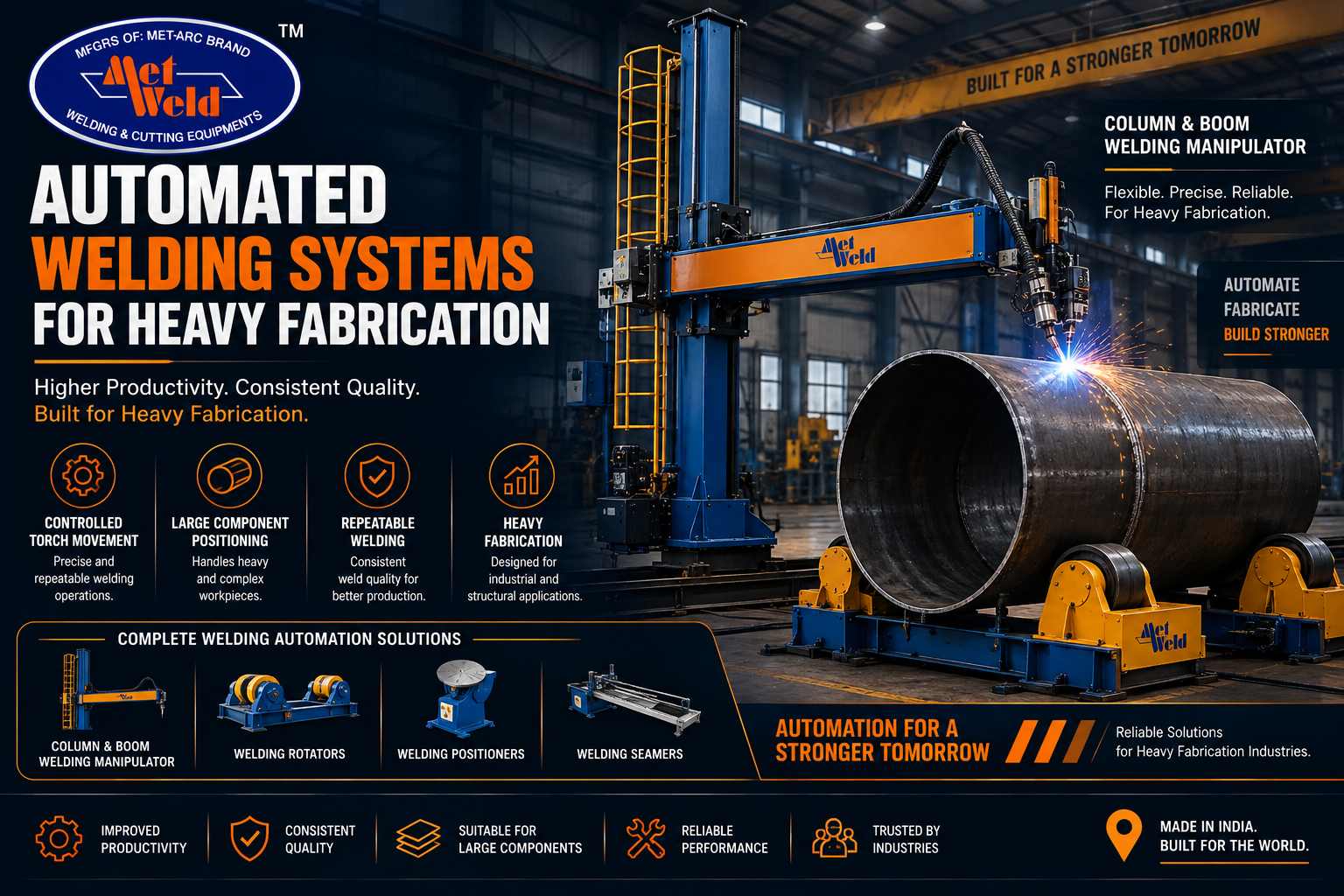
An automated setup may combine a welding power source with a rotator, positioner, column and boom or another mechanized arrangement. The configuration depends on vessel diameter, length, weight, joint geometry and welding process.
For pressure vessel fabrication, automation is useful for repeated longitudinal, circumferential and nozzle-related welding operations.
Mechanized welding systems can maintain controlled travel along a programmed or mechanically guided path. This can help reduce variations caused by manual torch movement and support more consistent welding operations across repeated joints. This is useful when similar vessels or components are produced repeatedly.
Pressure vessel components can be heavy and difficult to reposition manually. Welding rotators are designed to support and rotate cylindrical workpieces for automatic circumferential seam welding. This supports controlled rotation instead of repeated manual repositioning.
Automation can connect welding movement with a more structured fabrication sequence. CAD drawings, joint preparation, fit-up, positioning and welding can be planned as connected production stages. This reduces repetitive handling and lets operators focus on the welding process.
Pressure vessel manufacturing often involves repeated seams, nozzles, heads or other joint types. Once a suitable automated arrangement is established, recurring operations can be performed with a more consistent setup. This supports repeatable production with less reliance on manual welding.
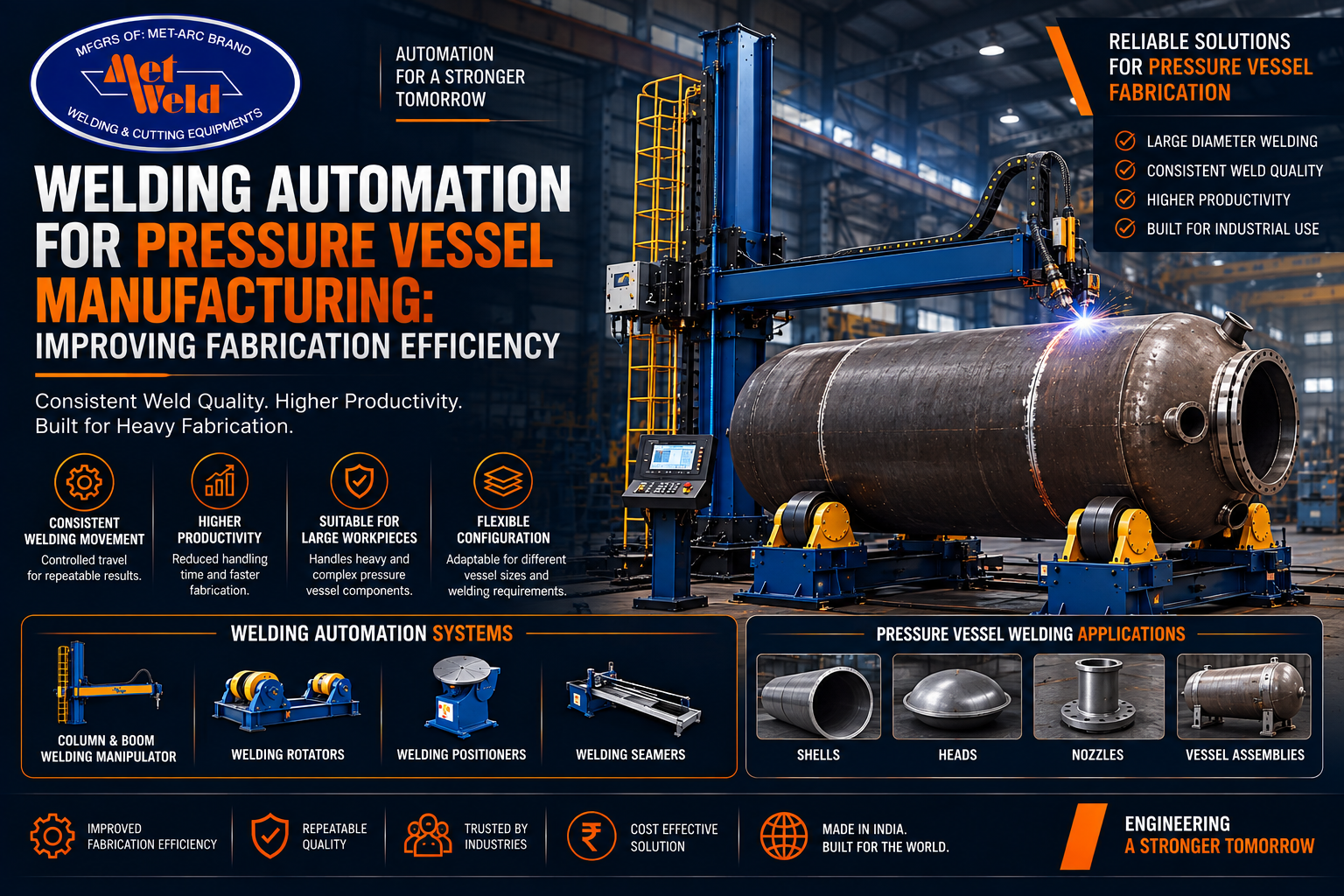
Welding automation can support several stages of pressure vessel and boiler fabrication. Rotator-based systems are commonly relevant to circumferential seam welding of cylindrical shells, while column and boom arrangements can help position welding equipment around larger workpieces. Specialized systems can also support nozzle and tube-related welding where joint geometry demands controlled movement.
Typical applications include shell seam welding, circumferential welding, nozzle attachment, pipe-to-vessel connections, head and shell fabrication, boiler components and other heavy welded assemblies. Metweld also offers specialized equipment for pressure-vessel-related applications.
Start with the actual range of vessel diameters, lengths and weights handled in production. Rotator capacity, support arrangement and machine travel should match the workpieces processed regularly.
The required welding process depends on material, thickness, joint preparation and production objectives. Identify the main joint types before selecting the automation arrangement.
The workpiece must remain stable while the welding head maintains the required relationship with the joint. Rotators, positioners and column and boom systems should be considered as one coordinated setup.
Low-volume custom fabrication and repetitive production may require different levels of automation. Recurring vessel designs may benefit from repeatable automation, while varied production may need greater setup flexibility.
Automation should simplify the welding workflow without making operation unnecessarily complex. Controls, accessibility, maintenance and operator training should be reviewed before finalizing the system.
Metweld provides industrial welding automation equipment for applications that require controlled and repeatable welding movement. Its product range includes welding rotators, column and boom systems, mechanized welding automation and specialized welding equipment.
For pressure vessel manufacturing, rotators can be considered for automatic circumferential seam welding, while column and boom arrangements can provide controlled positioning of welding equipment around large workpieces. Specialized systems are also available for particular vessel-related joints and applications. The combination should be selected according to vessel dimensions, weight, joint geometry, welding process and production volume.
Successful automation depends on more than purchasing a welding machine. Joint preparation, fit-up, handling, welding parameters, consumables and inspection all influence production results. The automation system should therefore fit naturally into the manufacturer’s existing fabrication sequence.
Before implementation, manufacturers should map the recurring welding operations, identify handling constraints and determine where controlled movement can replace repetitive manual work. For manufacturers comparing pressure vessel welding automation systems, the assessment should cover vessel size, joint type, welding process, positioning requirements and the complete production sequence.
Proper setup and operator training are important for consistent use and maintenance.
Metweld has been manufacturing welding and cutting equipment since 1982 and began manufacturing CNC plasma cutting machines in 2011. Its product portfolio includes mechanized welding automation, welding equipment, column and boom systems and rotators, supporting applications across multiple industrial sectors.
For pressure vessel manufacturers, this broader capability can help integrate welding automation with plate preparation and other fabrication processes.
Welding automation can provide pressure vessel manufacturers with a practical way to improve welding consistency, workpiece handling and repetitive production operations. Rotators, column and boom systems and specialized welding automation can each address different stages of vessel fabrication.
The right solution should be selected according to vessel dimensions, weight, joint type, welding process, production volume and operators. Evaluating the complete workflow helps ensure useful automation without unnecessary complexity. Manufacturers looking for automated pressure vessel welding solutions can assess Metweld’s equipment range according to their specific application and production needs.