Wherever one pipe meets another, someone has to cut a saddle. Boiler headers, pressure vessel nozzles, process piping branches, manifolds, tubular trusses, offshore jackets and handrail systems all depend on pipe-to-pipe intersections. The shape of these cuts is three-dimensional and changes with every combination of diameter, wall thickness, intersection angle and offset. Getting it right decides how well the joint fits, how much welding it needs and whether it passes inspection.
Many shops still rely on paper templates, hand marking and manual gas cutting for these joints. It works, but it is slow, depends heavily on individual skill and often requires grinding and rework to achieve acceptable fit-up. This guide looks at the main types of pipe intersection cuts, the limitations of manual methods and how CNC saddle cutting changes the process.
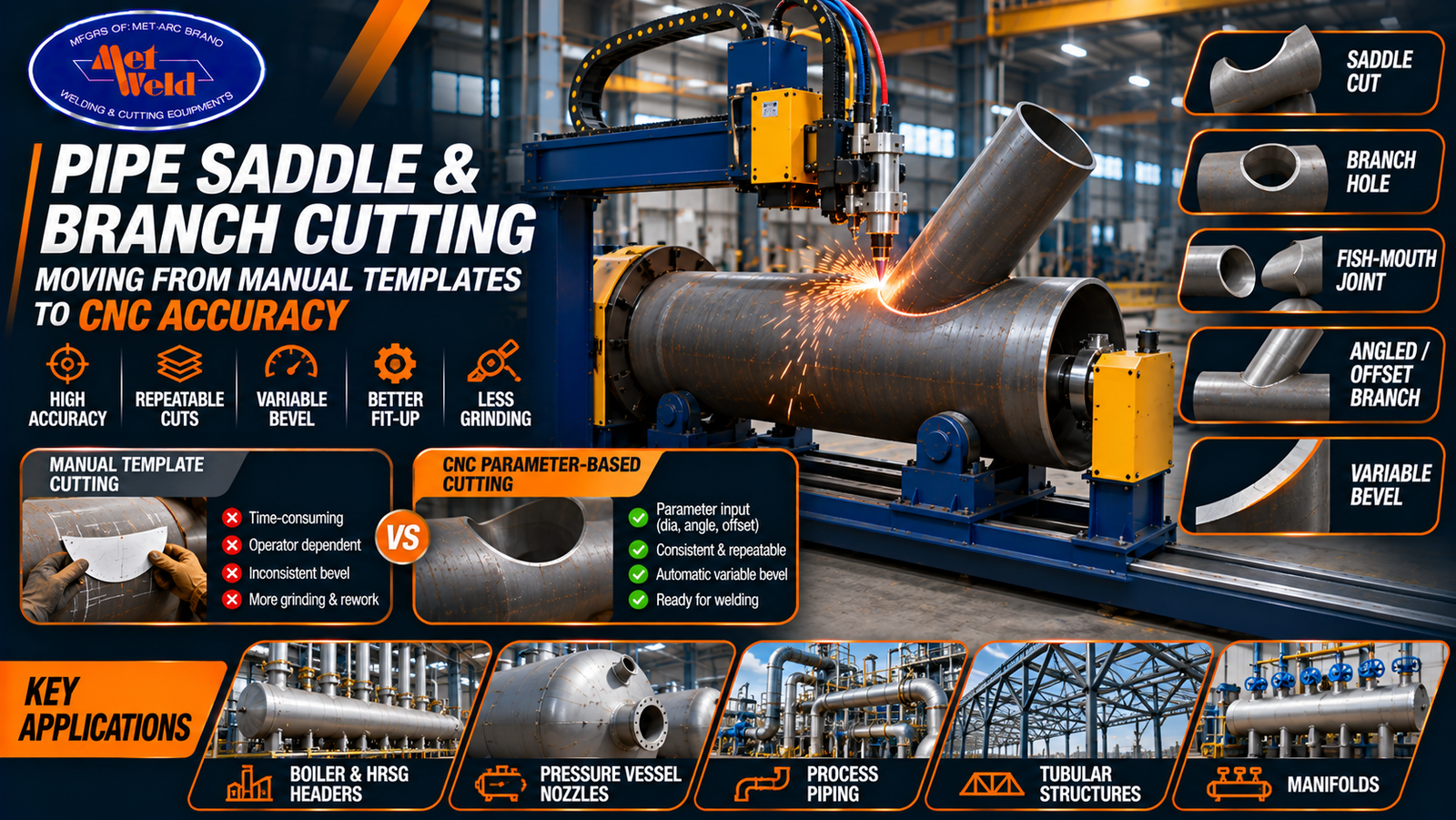
The end of the branch pipe is contoured to sit on the outside of the main pipe. The cut follows a curve that matches the main pipe’s outer surface.
A hole is cut in the main pipe so the branch can pass into it. The hole shape is a three-dimensional curve on the main pipe’s surface, not a simple circle.
A common name for saddle cuts on tubular structures, especially when pipes of similar diameter meet.
When the branch axis does not meet the main pipe’s centreline, or meets at an angle other than 90 degrees, the profile becomes asymmetric and much harder to mark manually.
Most pressure-retaining joints need a bevel for full-penetration welding. On a saddle, the bevel angle relative to the pipe wall changes continuously around the joint. This variable bevel is the hardest part to achieve by hand.
For one-off jobs, these limitations may be acceptable. For headers with dozens of stubs, or structures with hundreds of tubular joints, they become a serious bottleneck.
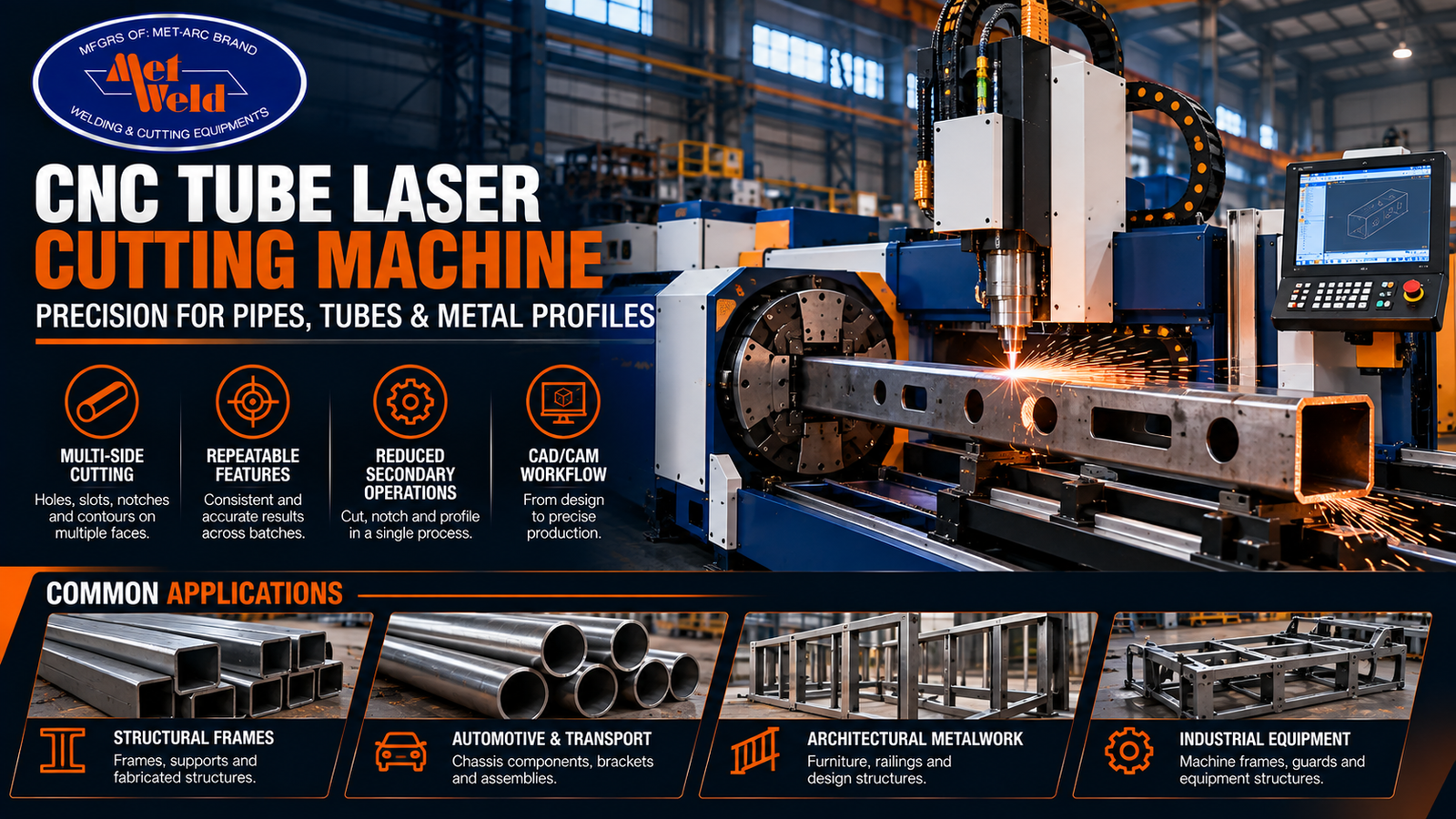
A CNC pipe saddle cutting machine rotates the pipe while a cutting torch moves along its axis, and in many machines tilts to produce bevels. The CNC calculates the exact profile from simple inputs such as main and branch diameters, wall thickness, angle and offset.
Key capabilities include:
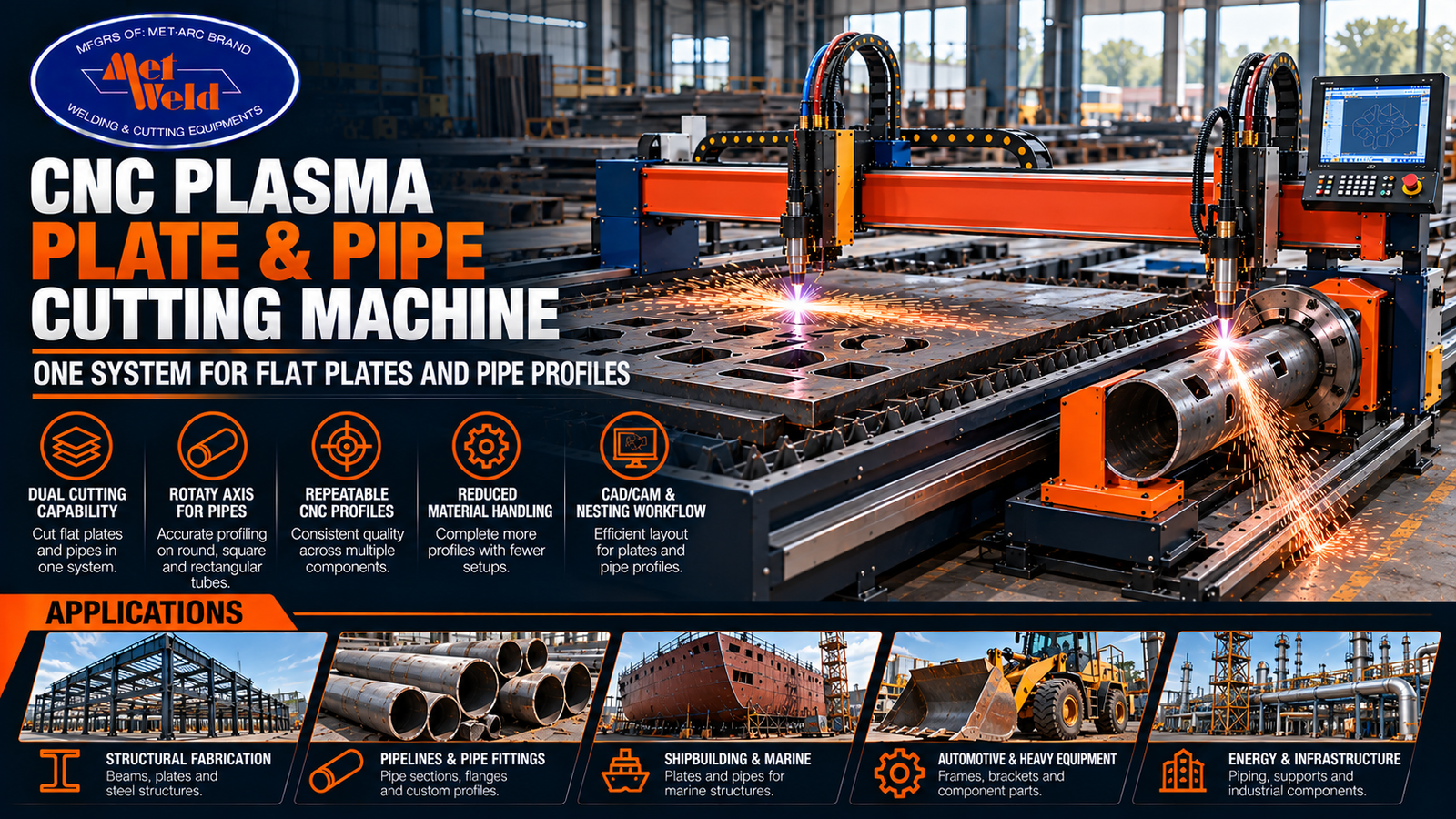
Metweld’s four-axis NC saddle cutter is designed specifically for these applications. For general pipe and plate work, the CNC plasma plate and pipe cutting machine combines flat plate cutting with a rotary axis for pipes.
| Factor | Manual templates | CNC saddle cutting |
| Setup for new size | Develop and transfer template | Enter parameters |
| Accuracy | Depends on operator | Consistent and repeatable |
| Variable bevel | Difficult | Automatic |
| Fit-up quality | Often needs grinding | Ready for welding |
| Throughput | Slow | Fast for batches |
| Skill dependency | High | Lower after training |
Our page on CNC plate cutting machines for the pressure vessel industry explains how accurate plate and pipe preparation supports vessel fabrication.
Accurate saddles and holes have a direct effect on welding:
For circumferential welds on branches and nozzles, a welding positioner brings the joint into a comfortable position. Metweld’s pipe welding solutions, including the Pipe Ace and large pipe welding systems, help complete the workflow.
Consider the following when selecting a machine:
Carbon steel, stainless steel and alloy pipes behave differently during thermal cutting. Carbon steel cuts readily with both oxy-fuel and plasma, and oxy-fuel remains economical for heavy walls. Stainless steel and other non-ferrous pipes cannot be cut with oxy-fuel and need plasma. Alloy steels used in high-temperature service may need preheating before cutting and careful control of the heat-affected zone, followed by light grinding of the bevel face before welding. Coated or lined pipes require attention to coating removal around the cut area. Discussing these details with your supplier helps select the right process and consumables from the start.
Shops moving from manual to CNC saddle cutting usually start with their most repetitive work, such as header stubs or standard nozzles. Programmers and operators learn the software on familiar jobs, then gradually move more complex and offset joints to the machine. Within a few weeks, the reduction in marking time and grinding becomes clearly visible in shop schedules.
Training should cover pipe loading and alignment, entering joint parameters, selecting cutting process and consumables, and inspecting fit-up. A short trial with the welding team helps confirm that the bevel geometry suits their procedures.
Metweld manufactures and supplies saddle cutting, pipe cutting and pipe welding equipment for boiler makers, vessel fabricators, piping contractors and structural fabricators. Our engineers review your typical pipe sizes and joint types, recommend the right machine and support installation and training.
Contact Metweld to discuss saddle and pipe cutting for your projects.
Can a CNC saddle cutter cut holes in the main pipe as well as saddles on the branch?
Yes. Most CNC saddle cutting machines can cut both branch saddles and the matching holes in the main pipe.
Is plasma or oxy-fuel better for saddle cutting?
Plasma is faster on thinner and medium walls and works on stainless steel. Oxy-fuel is preferred for very thick carbon steel walls.
Do I need CAD drawings to program saddle cuts?
Usually not. Saddle cutting software generates the profile from parameters such as diameters, wall thickness, angle and offset.