Heavy fabrication involves large components, repeated welds and demanding production workflows across structural steel, industrial equipment, construction, engineering and infrastructure applications. Welding is often a significant part of these operations, so consistency in torch movement, joint preparation and production sequence can affect both fabrication efficiency and downstream assembly.
Automated welding systems for heavy fabrication provide a controlled way to mechanize or automate welding movements for suitable production tasks. Metweld welding automation solutions
can be evaluated according to the workpiece, weld type, component dimensions, production volume and level of automation required. The objective is not simply to replace manual welding, but to create a more repeatable process where automation provides a practical advantage.
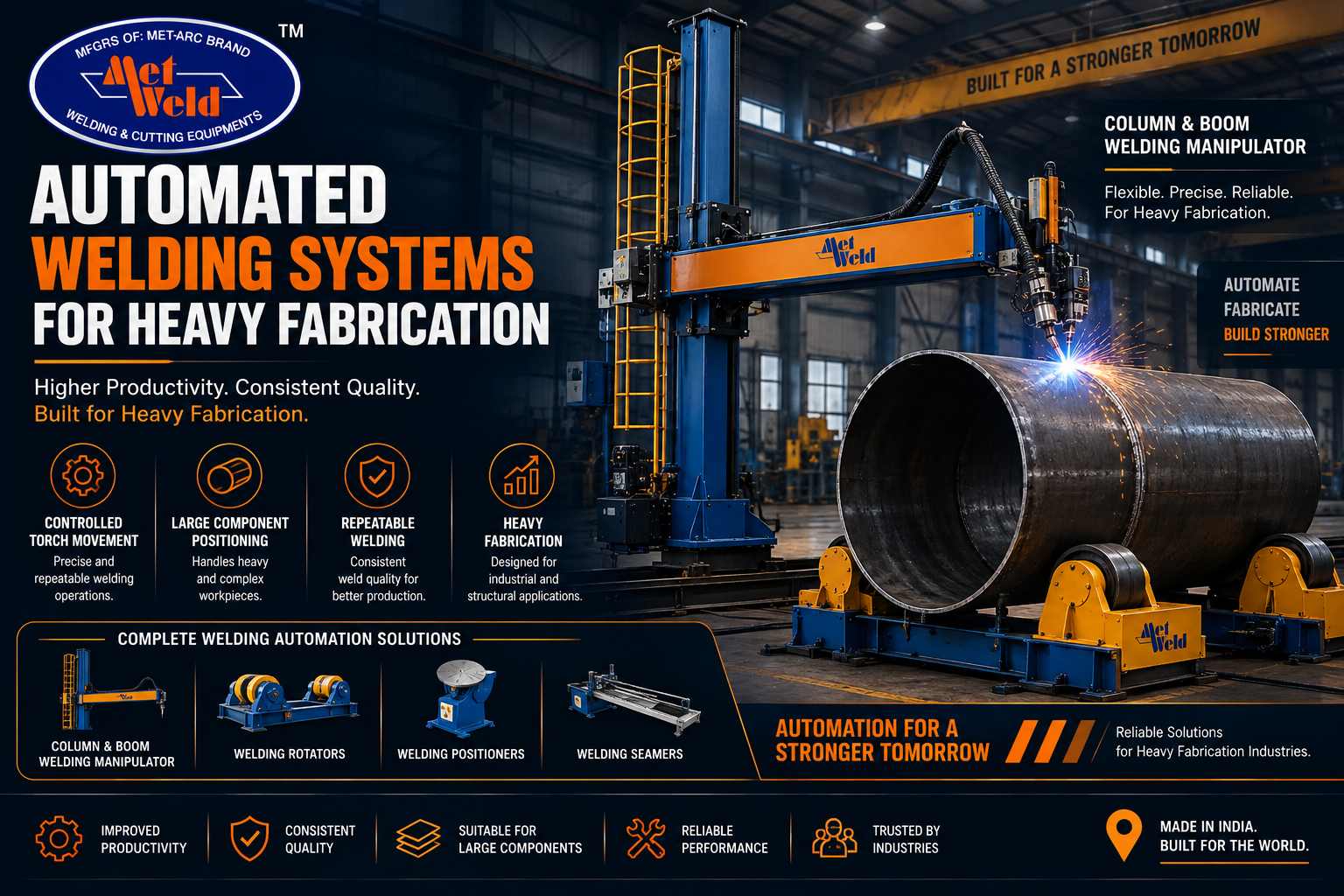
An automated welding system uses mechanical equipment to control some or all of the welding movement while the welding process is performed under defined operating conditions. Depending on the application, the setup may involve a welding manipulator, positioner, rotator, column-and-boom arrangement or another coordinated system.
Automation is particularly useful when the same welding movement needs to be repeated across similar components. Controlled travel can support consistent torch positioning and weld placement, while the workpiece can be positioned to make the joint more accessible. This can reduce unnecessary manual handling and create a more organized production sequence.
Mechanized torch travel can maintain a defined movement pattern across suitable welds. Consistency in travel and positioning can help reduce variation between repeated components and support predictable downstream fabrication. Weld quality still depends on joint preparation, process parameters, consumables, operator oversight and the condition of the equipment.
Heavy fabrication often involves workpieces that are difficult to reposition manually. Positioners, rotators and manipulators can help present a joint in a practical orientation for welding. Better positioning can make the welding operation more systematic while reducing unnecessary movement of heavy workpieces.
Automation can connect welding movement with a defined production sequence. When recurring jobs are planned carefully, setup procedures and operating patterns can be standardized. This can make production easier to organize and can reduce reliance on improvised movement during repetitive welding tasks.
For suitable high-volume or repeat-production work, automated movement can support efficient welding cycles. The benefit depends on joint geometry, component mix, setup time and handling requirements. Automation is most useful when the process is stable enough for mechanized movement to provide a measurable production advantage.
Automated welding systems can be used for heavy fabrication processes where repeated welding, controlled torch movement, and accurate workpiece positioning are required. These systems can support applications involving large components, structural fabrication, industrial equipment, and other repetitive welding operations. The suitable automation setup depends on the component dimensions, weld type, production volume, and required level of automation.
Start by identifying the dimensions and weight of the components that will be welded regularly. The system must suit the physical characteristics of the workpiece and provide practical access to the required joints. Loading and unloading should also be considered as part of the complete workflow.
The welding process, joint geometry and weld position influence the automation approach. A recurring seam may require a different arrangement from a complex fabricated assembly with several joint orientations. Define the welding tasks first, then assess the equipment configuration that can provide controlled movement.
Positioners and rotators can change the orientation of a workpiece, while manipulators can move the welding torch or welding head. Coordinating these functions can improve access to suitable joints and reduce unnecessary manual repositioning. The required combination depends on the component and welding sequence.
Low-volume fabrication with varied components may benefit from flexible mechanization, while repetitive production can justify a more dedicated automated arrangement. Setup time, changeover requirements and the frequency of recurring jobs should be considered alongside expected workload.
Automated welding systems require suitable controls that allow operators to manage welding movement, positioning, and operating settings according to the production process. User-friendly controls can help operators monitor the welding operation, adjust the system when required, and maintain consistent movement during repetitive welding tasks. Proper operator training and clear operating procedures are important for safe and reliable use of automated welding equipment.
Manufacturers can also review welding automation systems according to component dimensions, weld geometry and production needs.
Metweld combines welding and cutting equipment manufacturing with welding automation solutions for industrial applications. Its range includes equipment such as column-and-boom welding manipulators, welding rotators and welding positioners, which can be evaluated for different heavy-fabrication workflows. Its welding automation systemscan be evaluated according to component dimensions and production needs.
For fabrication businesses, these systems should be considered as part of the complete welding cell. Workpiece loading, torch access, welding equipment, operator controls, safety procedures and downstream handling all influence how effectively automation can be integrated into production.
Reliable automation begins with defining the welding sequence and preparing the workpiece correctly. Joint preparation, fit-up, positioning and program or movement settings should be established before production. Clear operating procedures help ensure that repeat jobs are approached consistently.
During operation, operators should monitor torch setup, welding parameters, consumables and workpiece positioning. Routine inspection and maintenance of moving components, fixtures and welding equipment can help identify issues before they affect production. Training is equally important because automated equipment still requires skilled oversight.
After-sales support is also relevant when adopting industrial automation. Installation assistance, operator training, service and spare-parts availability can help businesses maintain the equipment and address operational requirements over time.
Metweld brings manufacturing experience in welding equipment, CNC cutting technology and welding automation. Its automation portfolio includes different equipment configurations that allow manufacturers to consider solutions according to component dimensions, welding requirements and production needs.
For heavy fabrication, the value of automation depends on how well the equipment fits the actual production process. Reviewing the workpiece, joint type, positioning requirements and production volume can help identify an appropriate configuration instead of selecting equipment based only on general machine categories.
Automated welding systems for heavy fabrication can help manufacturers create more controlled and repeatable welding workflows for suitable production tasks. automated welding solutions can mechanize torch movement, workpiece positioning or both, depending on the selected configuration and application.
The right system should be chosen by reviewing workpiece size, weight, joint type, welding process, positioning needs, production volume and operator requirements together. For heavy fabrication businesses, a workflow-based approach can help identify practical welding automation that supports consistent production while keeping equipment and process requirements aligned.